
One of the project goals is to design and build a pilot plant (approx. 450L) to test the biomass production process in real-world conditions.
But what is the optimum design that can be used to grow a co-culture and tune methanotroph and phototroph growth ratio, gas, light, and heat consumption?
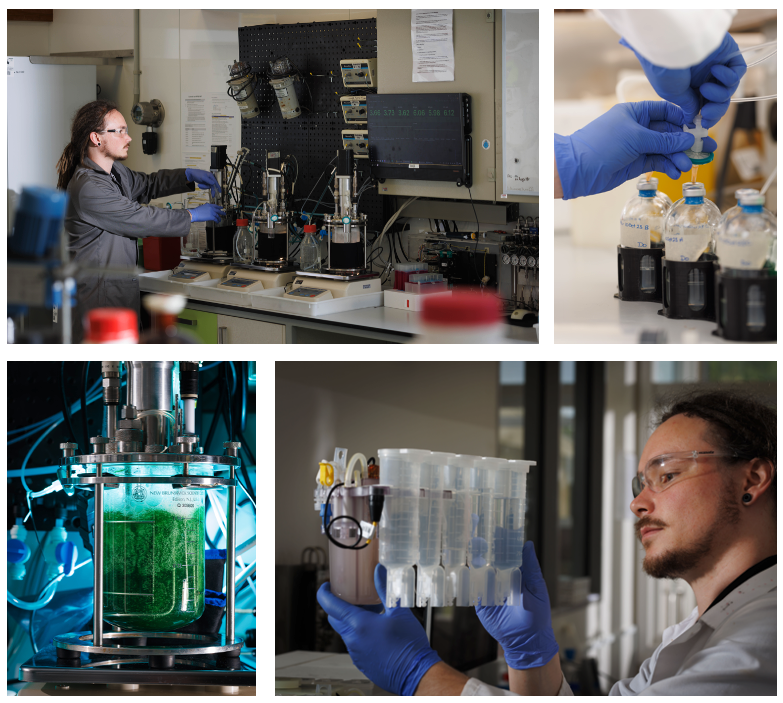
Over the past few months, laboratory scale test work has been undertaken at the University of Canterbury and at Bioeconomy Science Institute (BSI)-Scion Group to determine and validate some of the key operating parameters and assumptions as inputs for the pilot plant design. These studies have taken advantage of the bioreactor facilities, analytical equipment and expertise in both research organisations.
The University of Canterbury hosted the project’s bioprocess engineer, Cristian Martinez, to run undertake airlift, bubble column and photobioreactor experiments. He built Galdieria populations in 1L flasks and then scaled up the culture sample using airlift apparatus. Flocculation tests were successful for Galdieria samples, and the bubble column work at successfully validated our calculations and models.

The objective of the lab-scale test work by the BSI-Scion Group, was to determine the impact of varying gas ratios and pressures on co-cultures, using 1L and 10L bioreactors. They also examined possible options to fractionate the biomass to evaluate potential high-value components. Galdieria was successfully grown at the different gas ratios, with growth rates observed as per expectations. Also, the gas–liquid mass transfer validation trials were successful, with results matching theoretical models that the project team have developed.
Next Steps
Our next step is to operate an 80L tubular photobioreactor. We are in the process of setting up this equipment on the BSI-Scion Group site in Rotorua, with the aim of:

