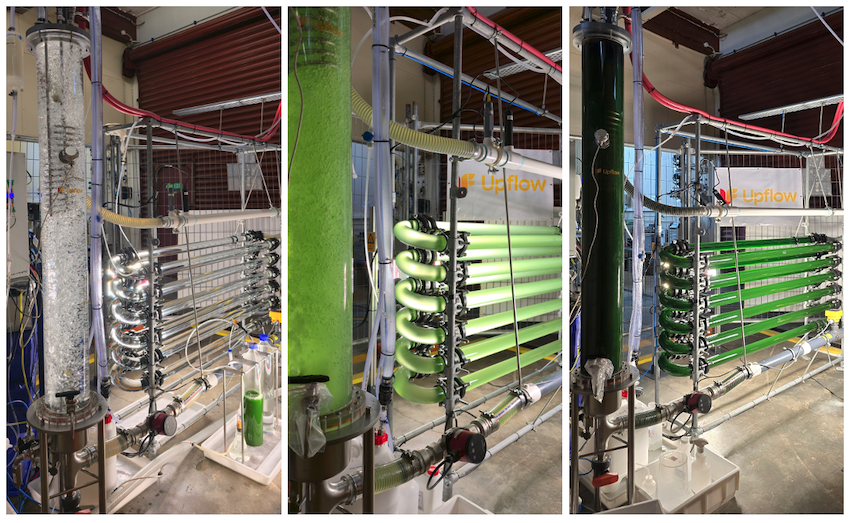
The Upflow team, led by our bioprocess engineer, Cristian Martinez, have constructed an 80L tubular photobioreactor on-site at the Bioeconomy Science Institute (BSI) in Rotorua to validate assumptions for the pilot plant design.
A photobioreactor is a closed system used to cultivate microorganisms by using light (natural or artificial) to drive photosynthesis. This reactor is constructed from transparent materials (in this case glass and plastic) to allow light penetration. A bubble column (i.e. the tall tube on left in figure) is used to introduce gases, heat the fluids and circulate the culture. The controlled environment allows us to manage pH, oxygen accumulation, nutrient levels, and temperature, and take samples for testing.
The reactor has been inoculated with Galdieria, a genus of extremophilic red microalgae that thrives in acidic, hot, sulfur-rich geothermal environments. This is a versatile microalgae that can switch between photoautotrophic mode (making all it needs from CO2 as the carbon source and light as its energy source) and hetero-organotrophic mode (consuming organic compounds, such as glucose, for energy and nutrients).
In the photobioreactor, the algae is happily photosynthesising and is a dark green colour (see figure).
This research is important to: