
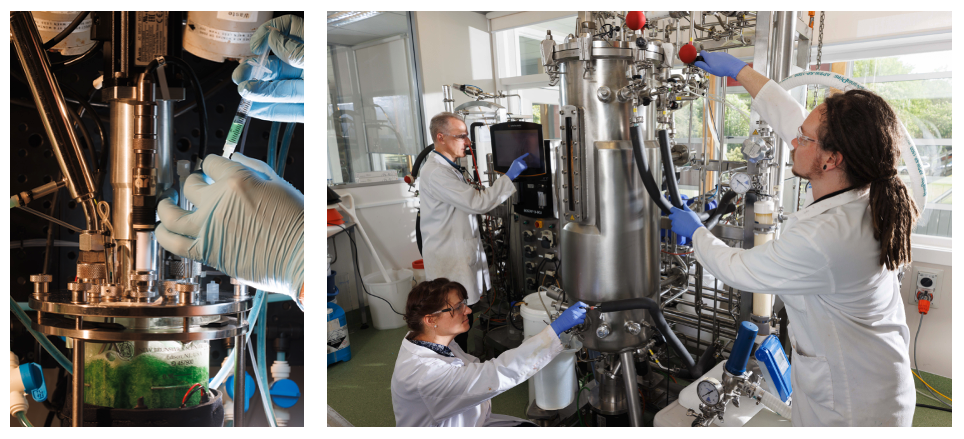
The technology behind this innovation project arose from a series of New Zealand-based research projects, with a key study being the PhD research of Dr. Carlos Cartin-Caballero. His research was part of a government-funded Endeavour Smart Idea titled ‘Flipping the paradigm: feeding methane to cows (2017-2020). This programme aimed to develop a biotechnology platform to take industrial waste gases and convert them into protein-rich biomass to feed livestock and other farmed animals (including aquaculture). The lab-scale process and bioreactors were designed to be nutritionally flexible, allowing the biomass to be tuned to meet market needs.
Two recent publications (with more to come!) explain in more detail the research and findings that are the foundation for the current project:
Cartin-Caballero, C., Collet, C., Gapes, D., Gostomski, P. A., Stott, M. B.; Carere, C. R. (2025). DSOF: A Rapid Method to Determine the Abundance of Microalgae and Methanotrophic Bacteria in Coculture Using a Combination of Differential Sedimentation, Optical Density, and Fluorescence. Bioengineering, 12(9), 1000.
This paper (published in September 2025) presents a rapid, low-cost method to determine the abundance of the members of microbial co-cultures. Cocultivation of phototrophic microalgae and aerobic methanotrophs represents an emerging biotechnology platform to produce high-protein biomass, yet quantifying individual species in mixed cultures remains challenging. The DSOF method provides a practical, scalable alternative to more complex, invasive or expensive techniques, enabling near real-time monitoring of microalgae–methanotroph cocultures.
Cartin-Caballero, C., Collet, C., Gapes, D., Gostomski, P.A., Stott, M.B., Carere, C.R. (2025) Simultaneous co-cultivation of the thermoacidophilic methanotroph, Methylacidiphilum sp. RTK17.1, and the microalga, Galdieria sp. RTK37.1, for single cell protein production, Engineering Microbiology, 5(4), 100229.
This paper (published in December 2025) outlines the lab-scale bioreactor experiments undertaken to grow a thermoacidophilic (45°C, pH 2.5) co-culture of the verrucomicrobial methanotroph, Methylacidiphilum sp. RTK17.1, and the microalgae, Galdieria sp. RTK37.1. Both microorganisms were isolated from geothermally heated soils at Rotokawa, Aotearoa-New Zealand. Their biomass productivity and performance was assessed, with the goal of removing methane and carbon dioxide from simulated waste gas streams and assessing the resultant biomass for its potential use as single cell protein. The co-culture displayed similar nutritional profiles, with protein quality comparable to soybean meal and fishmeal feeds used for animals.


